
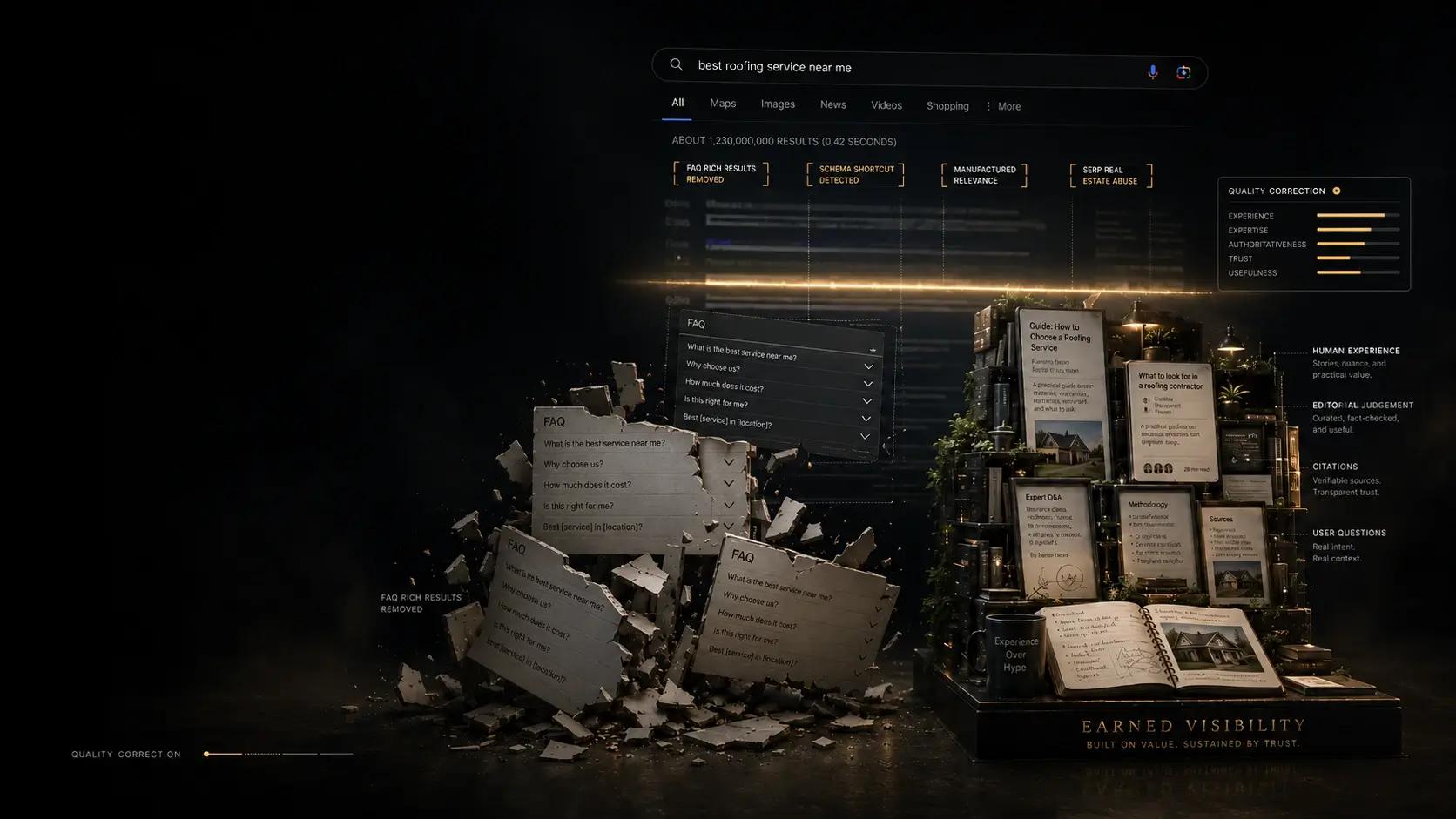
It is the oldest story in the digital playbook. A story of a 'shiny new toy', the inevitable gold rush of the unenlightened, and the ultimate, heavy-handed correction. I am talking, of course, about Google's final, absolute removal of FAQ rich results from the search ecosystem.
If there is ever a so often overlooked resource and in so many cases, it is the secret sauce, it is people. Yes, people, who would figure the most important marketing and advertising medium, in business, would be people. The inability for people to see outside the box, the fog, the pre sold, broken, programming that spawned the industry we know today as, SEO.
The Inevitable Cycle
Google introduces a feature — in this case, FAQ schema — designed to help users get quick answers. What does the SEO industry do? They treat it like a cheat code. They wrap every mundane, irrelevant sentence in FAQ schema, pushing competitors down the page, taking up SERP real estate like a bloated, digital landlord.
"Programmatic SEO is often a fancy banner for spam."
— John Mueller
It became a culture soup of manufactured relevance. And now? Google has pulled the plug. As of May 2026, FAQPage structured data is officially deprecated for rich results. You can leave the code on your site — it won't hurt you — but it will not buy you that coveted extra inch of screen space.
Why? Because we are about actual societal progress, and Google, despite its many flaws, is ultimately trying to serve the user, not the marketer. When a feature is weaponized to the point of uselessness, it is removed.
The 'Secret Sauce' They Keep Missing
The 95% — the great unwashed of digital marketing — are currently panicking, wondering what the next 'hack' is. They are looking for the next piece of schema to exploit, the next loophole to jump through.
The 5%, however, the ones who actually understand that business is fundamentally about connecting with people, are completely unfazed.
- They build ecosystems, not isolated landing pages.
- They write content that answers questions because the user needs the answer, not because a schema tag requires it.
- They understand that 'history' repeats itself, and the algorithm always corrects toward quality.
There is no denying that 'society' likes 'round pegs for neatly fitting round holes'. The SEO industry wanted FAQ schema to be that neat, round hole. But reality is far messier.
If you want to survive the next inevitable feature deprecation, stop optimising for the machine. Stop being a 'suckhole' to the algorithm. Start being a conduit for actual, valuable information. Write for the person reading the screen. It is, quite frankly, the dogs bollocks of marketing strategies, and it is the only one that never gets deprecated.
References
[1] Google Search Central. (2026, May 7). Simplifying the search results page. https://developers.google.com/search/blog/2026/05/simplifying-search-results
[2] Mueller, J. (2024 ). On programmatic SEO and spam. Google Search Central.
Article 2: S-CTS and the End of the Programmatic SEO Delusion
Plain Text
We need to talk about the delusion of scale. Specifically, the delusion that you can use an LLM to spin up ten thousand variations of the same thin, soulless page, slap it on a domain, and call it a 'business'.
They called it Programmatic SEO. I call it what it is: a house of cards waiting for a stiff breeze. And that breeze just arrived, carrying the rather clinical acronym: S-CTS.
Enter the Scalable Cluster Termination System
DeepMind recently published a paper detailing the Scalable Cluster Termination System. It is a multimodal defence system designed to hunt down 'Adversarial Synthetic Slop'.
For years, the 'unenlightened' have played a numbers game. Generate enough pages, and some of them will rank. It was a strategy built on the assumption that Google's crawlers were too slow, too localised, to see the bigger picture.
But S-CTS doesn't look at the page. It looks at the network. It looks at the cluster. In six months, it terminated 50,000 clusters comprising 130,000 channels of synthetic spam.
The Death of the 'Hack'
Business is not easy, well that is what we are told, although is the essence of business, not simply connecting people, with their needs and wants. How exactly does a programmatic page for 'Best Plumber in [Insert Obscure Town Here]' connect a human with a need, when the content was written by a machine that has never seen a wrench?
It doesn't. It is a simulation of value. A projected reality.
- It lacks the 'secret sauce' of human experience.
- It pollutes the digital ecosystem.
- It treats the user as a metric, rather than a person.
The people running these pSEO networks are now experiencing the very real, very grounded reality of a zero-traffic dashboard. They built their houses on sand, and are shocked — shocked — when the tide comes in.
Ground Zero
So, where does this leave us? Back at ground zero. Back to the fundamentals that the 5% have always understood.
You cannot automate authenticity. You cannot programmatic your way into being a trusted authority. If your entire strategy relies on generating content that a machine could write in three seconds, your strategy is already obsolete.
Build a genuine ecosystem. Write from the 'bones of your ass' — from real, hard-won experience. Stop trying to outsmart DeepMind, and start trying to actually help the person on the other side of the screen.
It is a novel concept, I know. But it might just save your business.
References
[1] Google DeepMind. (2026, June 19). Scalable Detection of Adversarial Synthetic Slop and Coordinated Media Abuse: A LoRA-Enabled Multimodal Defence System. Google Research.
[2] Google Search Central. (2024, March 5). Scaled content abuse policy update. https://developers.google.com/search/docs/essentials/spam-policies