
Articles
Essays, thoughts and notes.

How Website Speed Affects Conversion Rates and Bookings
There is a strange little religion in digital marketing, we find one impressive number, repeat it until it becomes folklore, then forget to ask what was actually measured. Website speed has suffered from this more than most subjects. One second equals this, one hundred milliseconds equals that, as if human behaviour were a vending machine and the right amount of latency simply produces a guaranteed booking. It does not.

What is EEAT and How does E-E-A-T fit in a LLM world
David Quaid [7] recently made the case that the SEO industry has fundamentally misunderstood EEAT. He argues, quite rightly, that the E-E-A-T framework was never meant to be a page-level checklist of author bios and trust badges, but rather an entity-level signal of genuine reputation. He points out that mentioning expertise is not the same as demonstrating it, and that the whole framework only really has teeth inside the narrow confines of YMYL topics.

S-CTS and the End of the Programmatic SEO Delusion
Google's new Scalable Cluster Termination System (S-CTS) is actively hunting and destroying AI-generated spam networks. If your business model relies on generating 10,000 thin pages, your days are numbered.

The Death of FAQ Schema and the Inevitable Spam Cycle
Google has finally killed FAQ rich results. It is the classic cycle: feature introduced, exploited by the SEO industry, and subsequently destroyed. Here is why you should stop chasing the algorithm and start building an ecosystem.
The Great GEO Grift: Why the 'AI Optimisation' Industry Has Causality Backwards
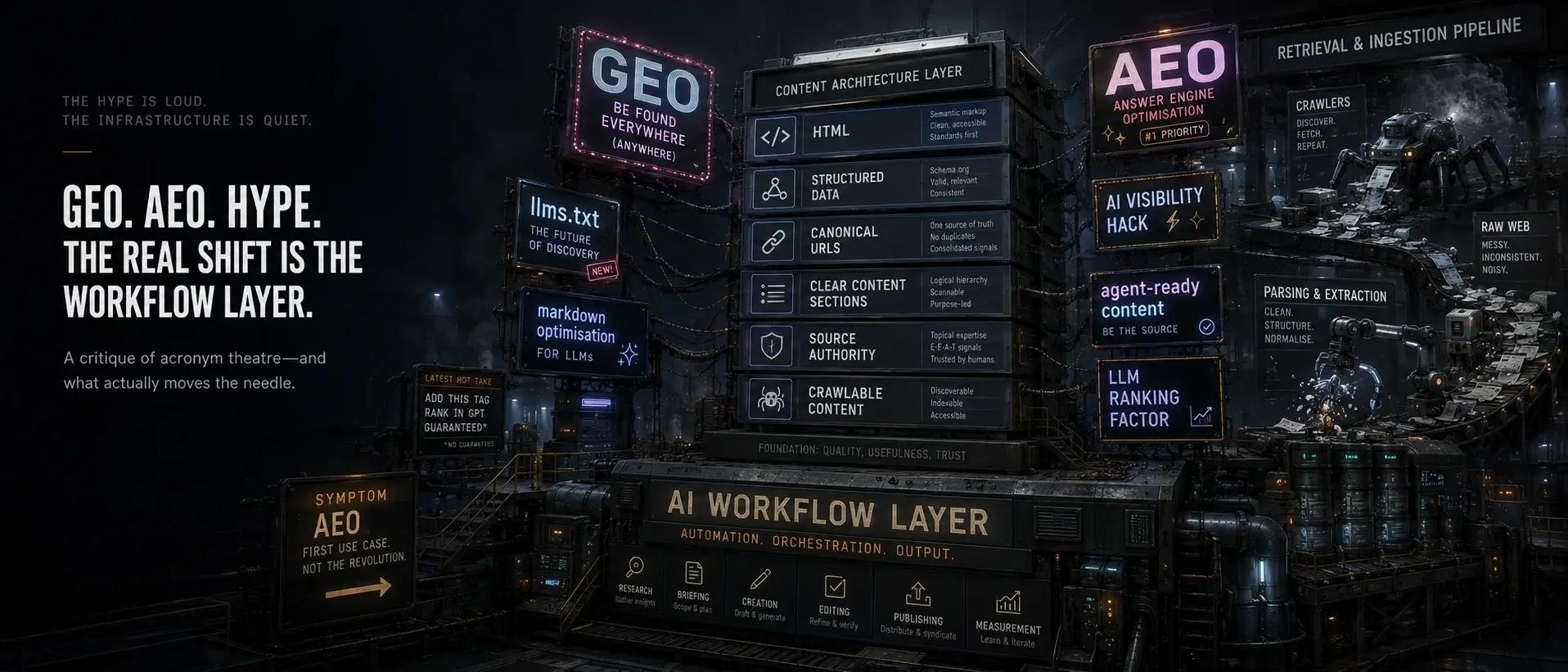
If you think Answer Engine Optimisation is causing the shift to AI and automation in marketing, you have causality backwards. AEO is not the driver, it's the symptom. Automation and AI workflows were coming regardless of whether AEO was a concept or not. The real story is not about optimising for the latest acronym. It is about understanding what is actually happening beneath the hype, and why GEO vendors are selling you solutions to problems that do not exist yet.

What Is a VPN, How Does It Work, and Can You Build One Yourself?
With the EU Digital Identity Wallet and UK Digital ID schemes now rolling out, everyone's talking about proving your identity to access the internet. Governments and platforms are pushing mandatory digital verification, age checks, and identity-linked services. So I decided to put together this comprehensive guide on VPNs, what they actually do, what they don't do, and why understanding them matters more than ever in a world moving towards identity-linked internet access.

The Brussels Effect: A Slow-Motion Extinction Event
We are witnessing a slow-motion extinction event. The European Union, in its infinite, arrogant wisdom, has decided that the only way to remain relevant is to govern every facet of our digital existence. They call it the 'Brussels Effect,' but for those of us on the ground, it feels more like a death grip. The AI Act, the Digital Services Act, and the Digital Markets Act.........these aren't shields for the citizen; they are the shackles of a regime that views every line of code as a potential crime and every entrepreneur as a suspect.
Why the Same Query Returns Different Answers: Randomness in AI Search
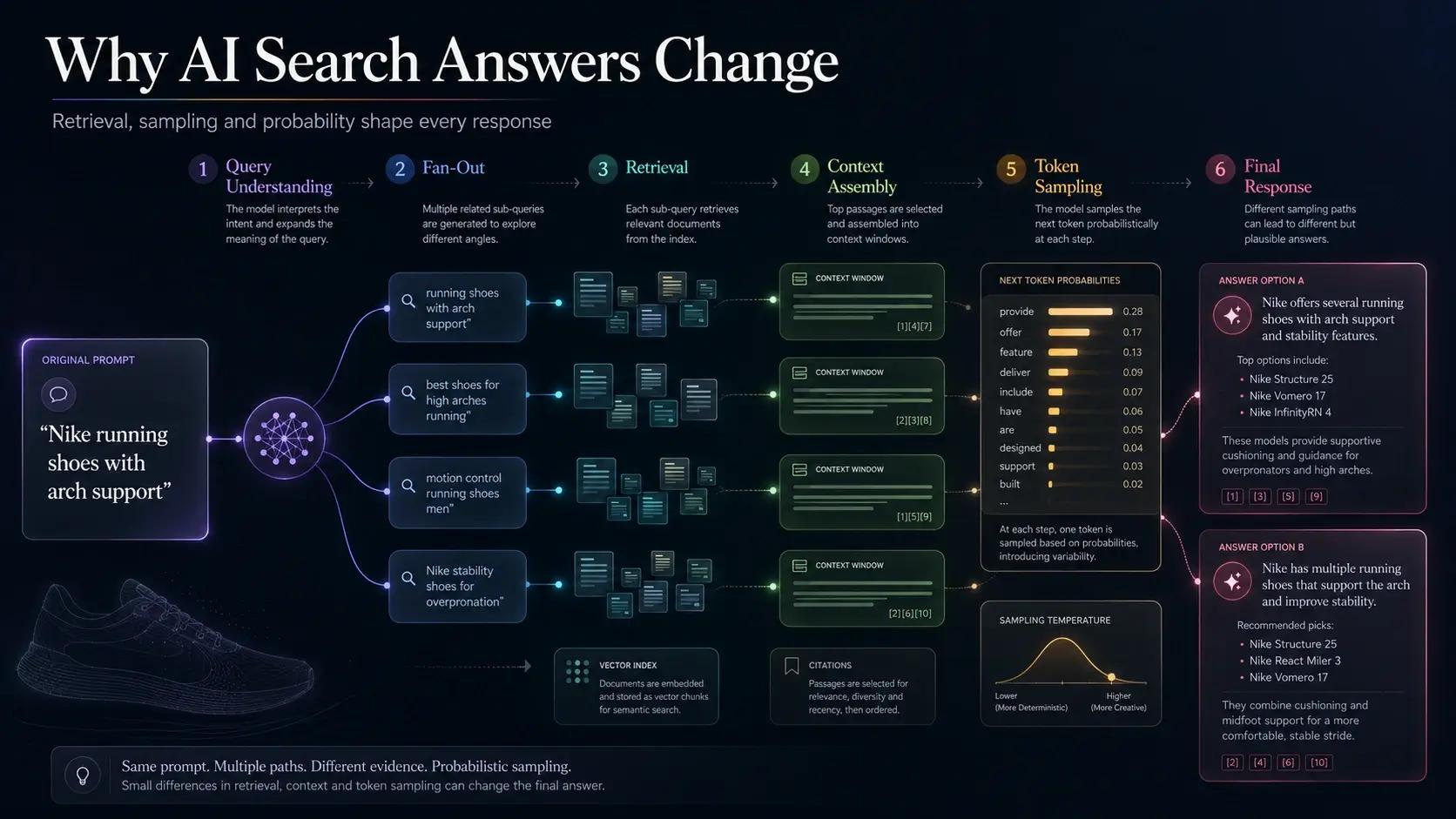
There is a comforting myth about AI search. It says that somewhere underneath it all sits a ranking, and if you play it right, you climb. There is no ranking. Between the question you ask and the answer you get sit six distinct stages: parsing, fan-out, retrieval, assembly, sampling, and citation. Each one introduces randomness on purpose, not by accident, and the variance compounds as it moves down the pipeline. This is a walk through all six, traced end to end through a single real query, so you can see exactly where the randomness enters, and why the whole idea of holding a fixed position falls apart.

The Same URL, Two Different Minds: Why Agentic SEO Leaves Chained Prompts Behind
Discover why agentic AI systems outperform chained prompts in SEO analysis. Learn when to use each approach, how they differ fundamentally, and why learning systems compound over time.

Guidelines of How To Rank In Google
The SEO industry has a persistent problem: it conflates technical requirements with ranking factors, and both with web design best practices. A website can be poorly structured, have messy HTML, lack proper heading hierarchy, and still rank well in Google. Conversely, a beautifully designed, semantically perfect website can be seemingly lost. The distinction matters enormously because it determines where you should invest your effort.
What is agentic AI, and why should anyone care?
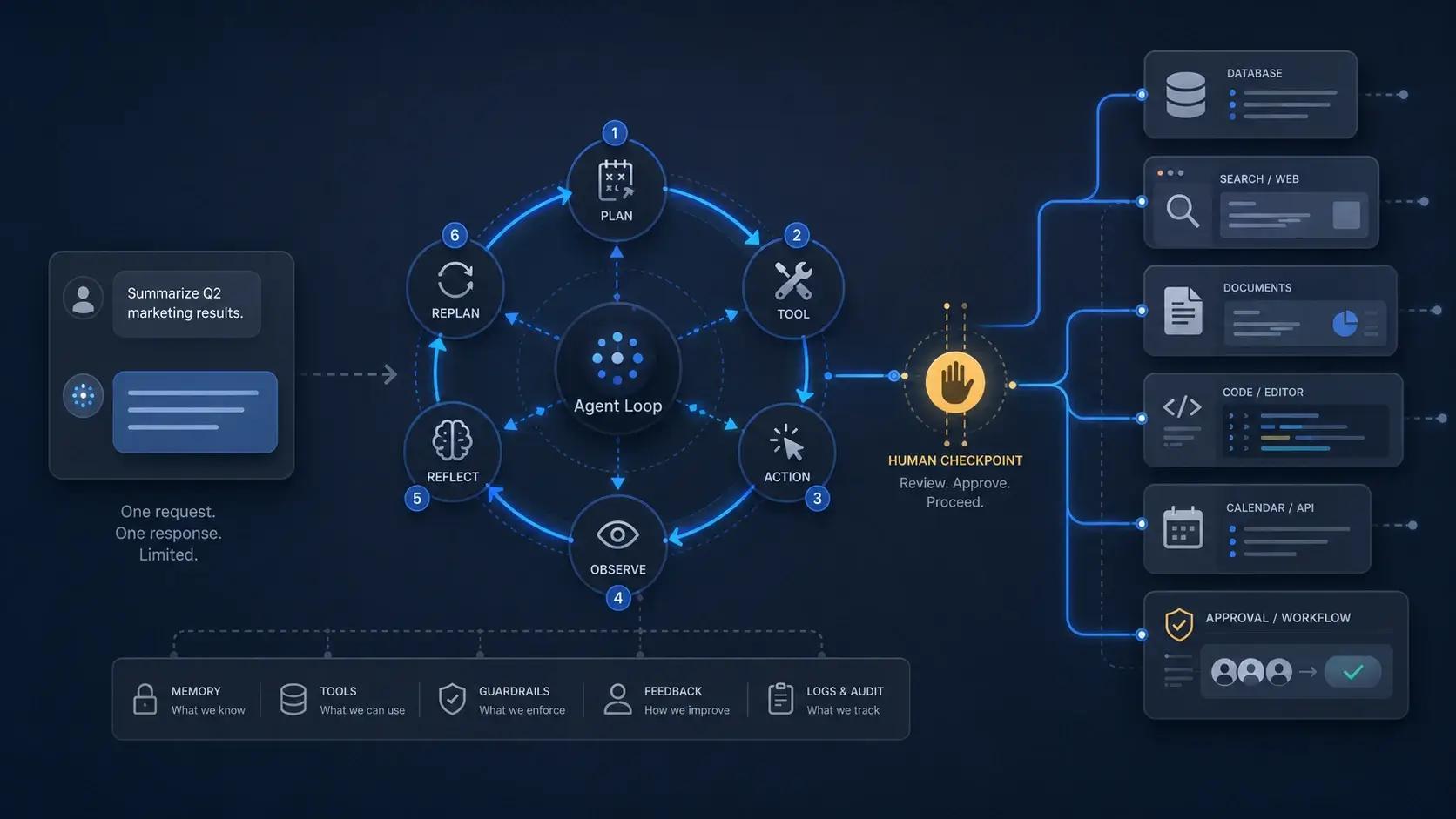
A grounded, sceptical explanation of agentic AI, how agents work, where the value sits, and where the hype starts taking the mickey.

What Is HTML-in-Canvas? The Future Of Web Design, SEO And AI
For decades, we have squeezed human ideas, products, places and experiences into the obedient little boxes of pages, menus and vertical scrolling, not because that was always the best shape for the web, but because it was the shape machines could understand. Jono Alderson’s piece on HTML-in-Canvas hints at something more interesting, a web where the semantic layer remains clean, crawlable and accessible, while the human experience is finally allowed to become richer, stranger and more alive.

Google Search I/O 2026: When Google Says SEO, Bing Shows What Search Is Becoming
Google’s Search I/O message is designed to reassure publishers that SEO still matters. Bing’s writing is more revealing: the search index is no longer just a system for ranking pages, it is becoming infrastructure for answers, citations, grounding and agentic decisions. The practical lesson is not to chase AEO theatre or machine-facing gimmicks, but to build content that can be crawled, trusted, extracted, cited and carried into an AI answer without losing its meaning.

Google Is Right About Google. That Is Not the Whole Map.
Google’s guidance on AI search is useful, but it is not universal law. It explains how Google wants us to think about Google Search, not how every AI system retrieves, grounds, cites and acts on information. SEO is still the foundation, yes, but the new competitive layer is evidence: passages that make sense, claims that can be trusted, entities that are corroborated, and websites that can be understood by both humans and agents.

Why Pure SPAs Should Be Avoided for General SEO
Pure client-side SPAs create needless SEO risk because crawlers, social bots, and AI retrieval systems must work harder to find content, links, metadata, and status signals.

Google's AI Optimisation Guide: The Funeral of AEO Theatre
Google's official AI Search guidance confirms that AI Overviews and AI Mode are grounded in core Search systems. Here is what matters, what does not, and why AEO theatre is not strategy.

HCU, thin content and the myth of word count
A few SEO arguments sound right because they are pointing at a real problem, but they still miss the thing sitting in the middle. HCU was not a word-count update, and short content is not automatically thin content. But that does not mean thin content is a myth, or that Google has no way to judge usefulness. The real issue is low-added-value content, the kind that has the shape of expertise, but none of the scar tissue.

Blue Sky Thinking for LLMs: Why AI Citations Will Be Gamed
Everyone now wants the same thing: to be the page ChatGPT, Gemini, Perplexity or Google’s AI results decide to quote when they answer a question. So the obvious search is, how do I get an LLM to cite my content? The honest answer is less comforting than the usual schema-and-optimisation chatter. LLMs want to cite clear, reliable, primary evidence. But the moment that preference becomes commercially valuable, it becomes a target. What begins as a noble little dream of machines rewarding the best source quickly becomes something older, rougher and more familiar: another algorithm people will learn to game.

AI Search Demands Technical Infrastructure, Not Shortcuts
When Google's AI Overview answers a search, it doesn't rank pages anymore, it synthesises claims. If your canonical information is expensive to extract, the system answers using someone else's version of you. That's not an SEO problem in 2026, that's a brand reality problem.

Why ChatGPT Cites Your Content (And Why Your Schema Doesn't Matter)
If there is ever a moment where the fog clears, where the broken programming of the SEO industry reveals itself for what it truly is, it is when you look at the data. Real data. Not the culture soup of marketing buzzwords, not the unenlightened 'GEO experts' claiming schema is the answer to everything, but actual evidence from 1.4 million ChatGPT prompts. Ahrefs released a study in April 2026 that should have sent shockwaves through the SEO community. Instead, most people missed it entirely. The study examined which pages ChatGPT actually cites, and the findings are damning for anyone who has been chasing the schema markup myth.

Structured Data & AI Crawlers in 2026: Why Most Schema Hype Is Misplaced
From hands-on experiments in late 2025 and early 2026, one pattern emerges clearly: most AI crawlers do not parse JSON-LD semantically. They tokenize the entire page as ordinary text. Search engines still use schema during indexing, but when their LLMs generate answers, they draw from algorithmic summaries and grounding snippets, not raw structured data feeds. The result? Visible, semantically clear HTML structure beats hidden schema for AI extraction in almost every case.

The Reality of Content Cannibalisation and Query Fan-Out in GEO
Many SEO practitioners now argue that content cannibalisation is less risky in the GEO era, given that LLMs use query fan-out to pull from multiple long-tail pages, even ones with significant semantic overlap. The strategy sounds efficient on paper: create 9-10 ultra-specific pages rather than consolidating into 3-4 broader ones. But 2026 data and real-world tests tell a different story. While AI Overviews do reward specificity and diverse angles, unchecked fragmentation with heavy overlap usually dilutes authority and citation potential. The smarter play, and the one the evidence actually supports, remains intentional intent separation backed by tight topical clustering.
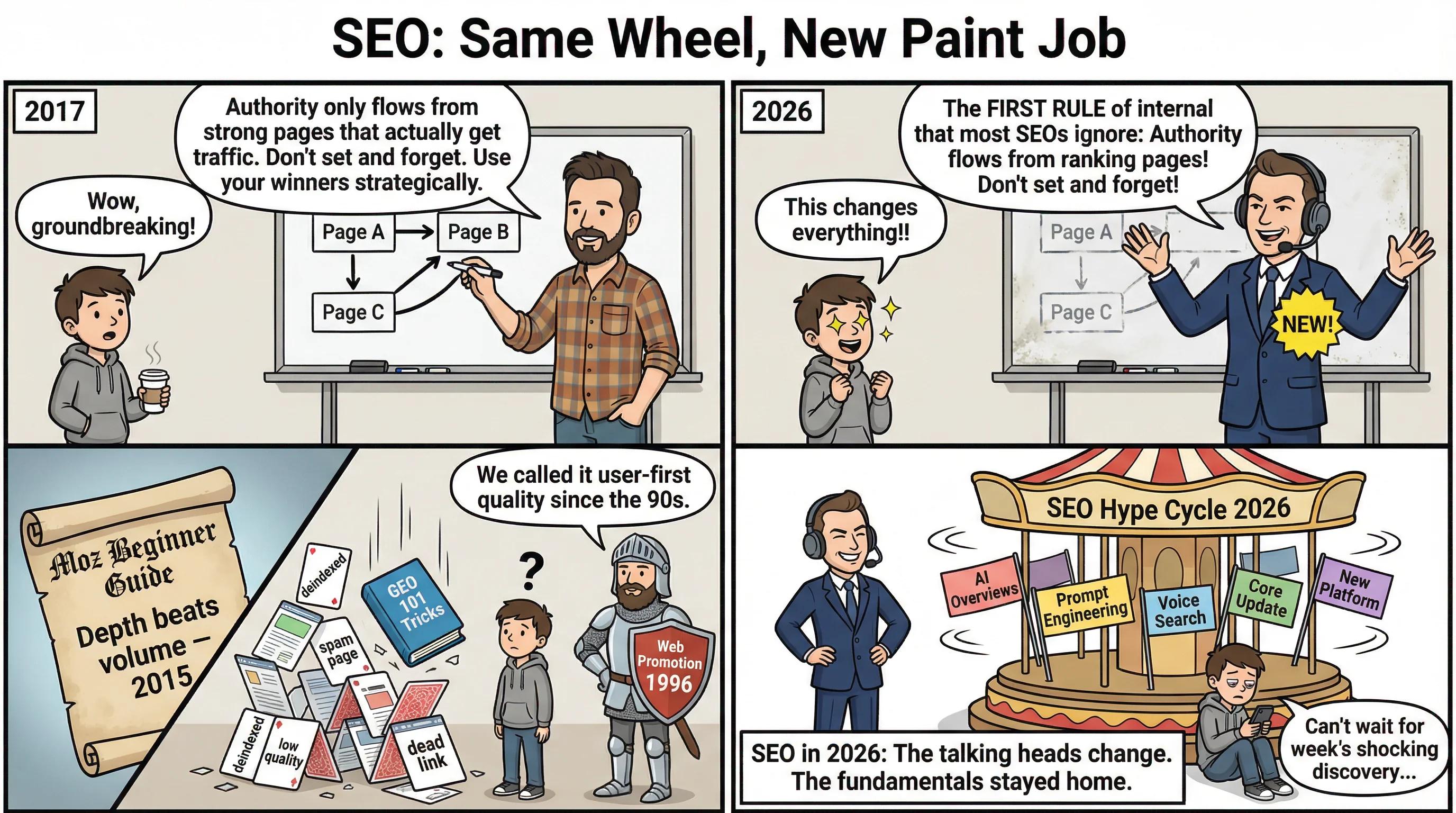
Nothing New Under the SERP: Why SEO Fundamentals Still Win
The SEO industry constantly reinvents the wheel with new buzzwords. But the core fundamentals of web promotion haven't changed in decades.

Ditch Subscription Creep for Good: Why Custom Apps Are Now the Smartest Cashflow Move for SMEs in 2026
SMEs waste 30% of their software spend on unused subscriptions. Custom apps now start at only €1,500 euros one-time. Here's how to escape the cycle.
Lost in Semantics: EEAT and the Problem of Artificial Ignorance
EEAT was meant to fix quality in search, but in the age of AI Overviews it's falling short. From keyword stuffing to Artificial Ignorance, why the gaming never really ended.

Badges Are for School Bags, Not Business Assets
Designers obsess over 'Human Crafted' badges and pixel-perfect animations. Consumers just want their problem solved. Here is the disconnect no one wants to admit.

Programmatic SEO in the Age of AI: From Scale to Signal
Programmatic SEO is evolving. Scale without signal produces noise. Learn how systems are shifting from ranking pages to retrieving and reusing information.
From Semantics to AI: The Same Debate, Repackaged
The industry is splitting over AI, but this is the same cycle we've seen before. Understanding the pattern reveals what really matters: inclusion over ranking.

The T-Shaped Professional: Why Breadth + Depth Beats Specialisation
Why breadth, not depth, is becoming the ultimate advantage in the age of AI — and why deep generalists are the most valuable professionals in an AI-driven world.