
There is a certain smell that comes with a new technology buzzword, and if you have been around long enough, you can catch it before the conference boys have even finished polishing their LinkedIn headshots. 'Agentic AI' is one of those phrases. It sounds important. It sounds expensive. It sounds like something a consultant might whisper into a procurement meeting before presenting a 94-slide deck with three diagrams, two stock photos, and not one ounce of lived reality.
And yet, annoying as the phrase may be, there is something real underneath it.
Agentic AI, or AI agents, represent a shift from systems that merely respond, towards systems that can pursue a goal, break that goal into steps, use tools, observe what happened, correct themselves, and continue until the work is finished, blocked, or needs human judgement. Anthropic makes a useful distinction here, workflows are systems where language models and tools follow predefined code paths, while agents are systems where the model dynamically directs its own process and tool use.1 That distinction matters, because without it we end up calling every mildly automated chatbot an 'agent', and that, frankly, is taking the mickey.
What is agentic AI?
Agentic AI is artificial intelligence designed with a degree of agency, meaning it can act purposefully towards a goal rather than simply waiting to be spoon-fed one prompt at a time. A normal generative AI system might answer a question, write an email, summarise a document, or create an image. An agentic system goes a stage further. It can decide what needs to happen next, select an appropriate tool, carry out an action, inspect the result, and adjust its plan.
IBM defines AI agent planning as the process by which an AI agent determines a sequence of actions to achieve a goal, involving decision-making, goal prioritisation, and action sequencing.2 That is the bones of it. Not magic. Not artificial consciousness. Not Deep Thought finally returning with the number 42 and a cup of tea. It is system design, wrapped around a language model, with tools, memory, permissions, and feedback loops attached.
The agent is not clever because it talks. It is useful because it can do, check, and do again.
A proper agentic system normally has several moving parts. It needs a model for reasoning, tools for interacting with the outside world, memory for holding context, and an execution loop that lets it continue beyond a single response. Weaviate describes agents as systems that combine LLMs for reasoning and decision-making with tools for real-world interaction, allowing them to complete complex tasks with limited human involvement.3
In plain English, the model is the brain-ish bit, the tools are the hands, the memory is the notebook, and the loop is the stubborn streak that keeps the thing moving.
Agentic AI vs generative AI
The easiest way to understand the difference is to look at the shape of the work. Traditional AI followed rules. Generative AI creates outputs. Agentic AI tries to complete objectives.
| Aspect | Traditional AI | Generative AI | Agentic AI |
|---|---|---|---|
| Primary behaviour | Follows fixed rules or classifications | Produces content from prompts | Pursues goals through steps and actions |
| Autonomy | Low | Mostly reactive | Higher, within permissions and guardrails |
| Tool use | Minimal or hard-coded | Sometimes available | Central to the system |
| Memory | Usually limited | Conversation-level context | Short-term and sometimes persistent memory |
| Best suited for | Narrow tasks | Writing, ideation, summarisation, generation | Multi-step work, research, operations, code, analysis |
| Main risk | Rigidity | Hallucination or surface-level output | Wrong action at scale, tool misuse, cost, drift |
The shift is not from 'bad AI' to 'good AI'. That would be too clean, and life is rarely that kind. The shift is from a single exchange to a working loop. Generative AI says, 'Here is an answer.' Agentic AI says, 'Here is the first step, I have checked it, here is the second step, and this is where I need permission before I go any further.'
That last bit is important. A good agent knows when to stop, escalate, or ask. A bad agent just keeps hammering away like a man trying to fix a watch with a shovel.
How agentic agents actually work
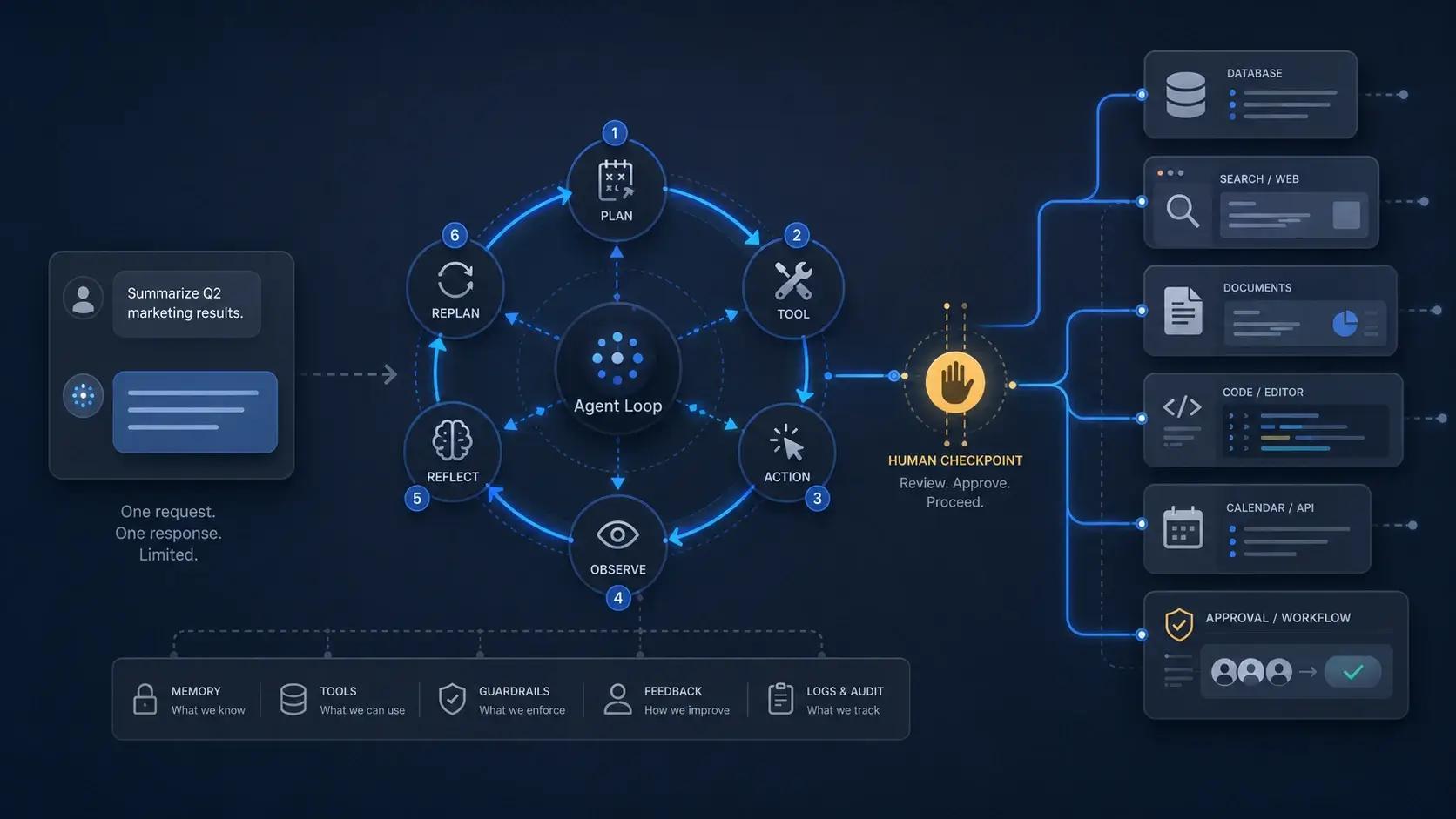
Most agentic systems are built around a loop. The wording changes depending on the framework or vendor, because every tribe needs its own little flag, but the underlying rhythm is fairly consistent.
- Goal parsing: the system interprets what the user or business actually wants.
- Planning: the system breaks the goal into smaller steps or possible routes.
- Tool selection: the system chooses what it needs, such as search, code execution, a database, a browser, a calendar, or an API.
- Action: the system carries out the next step within its allowed permissions.
- Observation: the system reads the result of that action, rather than pretending the action worked because it sounded good.
- Reflection: the system evaluates whether the result moves it closer to the goal.
- Replanning: if the result is poor, blocked, incomplete, or dangerous, the system changes course.
This is where the whole thing becomes interesting. A static prompt is a note passed across a desk. An agentic workflow is closer to a junior operator with a checklist, tools, and enough rope to be useful, or to hang the business if no one designed the system properly.
Anthropic argues that many successful agent implementations use simple, composable patterns rather than complex frameworks, and recommends starting with the simplest solution before increasing complexity.1 That is a wonderfully unfashionable idea, which is probably why it is worth listening to. The world is full of people building cathedrals where a shed would have done.
Common agentic patterns
Agentic AI is not one thing. It is a family of patterns. Some are tightly controlled workflows. Others are looser agents that decide their own route. The best system depends on the task, the risk, the available tools, and the tolerance for error.
| Pattern | What it does | Where it works well |
|---|---|---|
| Prompt chaining | Breaks a task into sequential LLM calls | Drafting, reviewing, translating, structured writing |
| Routing | Sends different inputs to different specialist paths | Support tickets, lead handling, content moderation |
| Parallelisation | Runs several subtasks or checks at the same time | Research, evaluation, security review, comparison work |
| Orchestrator-workers | A central agent delegates subtasks to specialist workers | Coding, research, complex file changes, multi-source analysis |
| Evaluator-optimiser | One model creates, another critiques, then the system improves | Writing, code review, search, quality assurance |
| Autonomous agent | The system plans and acts over many turns with tools | Open-ended tasks where steps cannot be fully predicted |
These patterns are not the dogs bollocks simply because someone gave them a name. They are useful when they fit the work. If the task is simple, a single model call with good context may beat an elaborate agentic circus. If the task is messy, open-ended, and tool-heavy, an agent may earn its keep.
Real-world examples of agentic AI
The clearest examples are not the sci-fi fantasies. They are boring, practical, slightly grubby bits of work where humans waste hours moving information between systems.
A personal travel agent could compare flights, check hotel availability, match dates against a calendar, prepare an itinerary, and ask for approval before booking. A software engineering agent can inspect a repository, identify a failing test, change code, rerun the test suite, and produce a pull request. A research agent can search across sources, collect evidence, compare claims, and prepare a structured brief. Customer support agents can triage tickets, retrieve account information, draft responses, and escalate the sensitive cases instead of pretending every human problem is a neat little dropdown category.
- Agentic systems are strongest where the work is multi-step, repetitive, evidence-based, and tool-dependent.
- They become more valuable when the system can observe real outputs, such as test results, retrieved records, API responses, or browser state.
- They are safest when humans approve irreversible actions, especially payments, publishing, medical decisions, legal commitments, or anything that can damage trust.
There is a cultural point here too. Businesses often think they are buying 'AI'. They are not. They are buying an operational redesign. The agent is only one actor in the ecosystem. The data, permissions, processes, tool interfaces, evaluation criteria, human checkpoints, and failure handling are the real machinery.
The hype check, because someone has to say it
The current problem with agentic AI is not that it is useless. It is that too many people are describing tomorrow's architecture as if it were already sitting reliably on every desk today. The demo economy is a dangerous place. Everything works beautifully when the task is chosen, the environment is controlled, and the person presenting has rehearsed the happy path seven times before breakfast.
Production is different. Production has edge cases, permissions, missing data, bad APIs, angry customers, expired tokens, weird spreadsheets, legal constraints, and humans who type things like 'as discussed' with no previous discussion available to the machine.
- Reliability: agents can hallucinate, misread tool output, loop unnecessarily, or complete the wrong task with great confidence.
- Cost: multi-step reasoning and repeated tool calls can burn through compute, API usage, and time.
- Security: an agent with access to email, files, databases, payments, or publishing systems needs strict permissions and audit trails.
- Evaluation: if you cannot measure whether the agent did the job properly, you do not have an agentic system, you have theatre.
- Accountability: when an agent takes action, someone still owns the consequence. The machine will not be sitting in the boardroom explaining itself.
This is why guardrails are not optional decoration. They are the seatbelts, brakes, mirrors, and road markings. Nobody sensible celebrates a powerful engine in a car with no steering.
What this means for business
The real value of agentic AI will not come from asking, 'How do we add agents?' That is the wrong question, born from the culture soup of trend-chasing and procurement panic. The better question is, 'Where do we have work that requires repeated judgement, tool use, checking, and follow-through?'
That might be sales operations. It might be SEO research. It might be technical QA. It might be customer service. It might be finance reconciliation. It might be internal reporting, where some poor soul spends every Friday stitching together dashboards so leadership can pretend the numbers were obvious all along.
Agentic AI becomes useful when it is pointed at a real constraint. Not a fantasy. Not a 'digital transformation initiative', which often means a committee has discovered a new noun. A real constraint. A bottleneck. A task that drains attention. A process where the human value is judgement, not clicking the same button 400 times.
The question is not whether agents will replace people. The sharper question is which people will learn to command systems, and which people will remain trapped inside systems built by someone else.
Final thought
Agentic AI is not a saviour, and it is not a toy. It is a conduit. A new layer between intention and execution. Used well, it can remove the repetitive drag from knowledge work and let people focus on judgement, taste, strategy, empathy, and the strange human ability to know when something smells wrong even before the spreadsheet admits it.
Used badly, it becomes another shiny object, another expensive abstraction, another way for businesses to automate confusion and call it progress.
So, is agentic AI the future? In part, yes. But only for those who understand that the model is not the whole system. The secret sauce is the design around it, the tools, the memory, the permissions, the feedback, the human checkpoints, the cultural willingness to stop worshipping novelty and start building useful things.
Because technology, at its best, is not the replacement of human agency. It is the amplification of it.