
Tag
ai search
3 posts
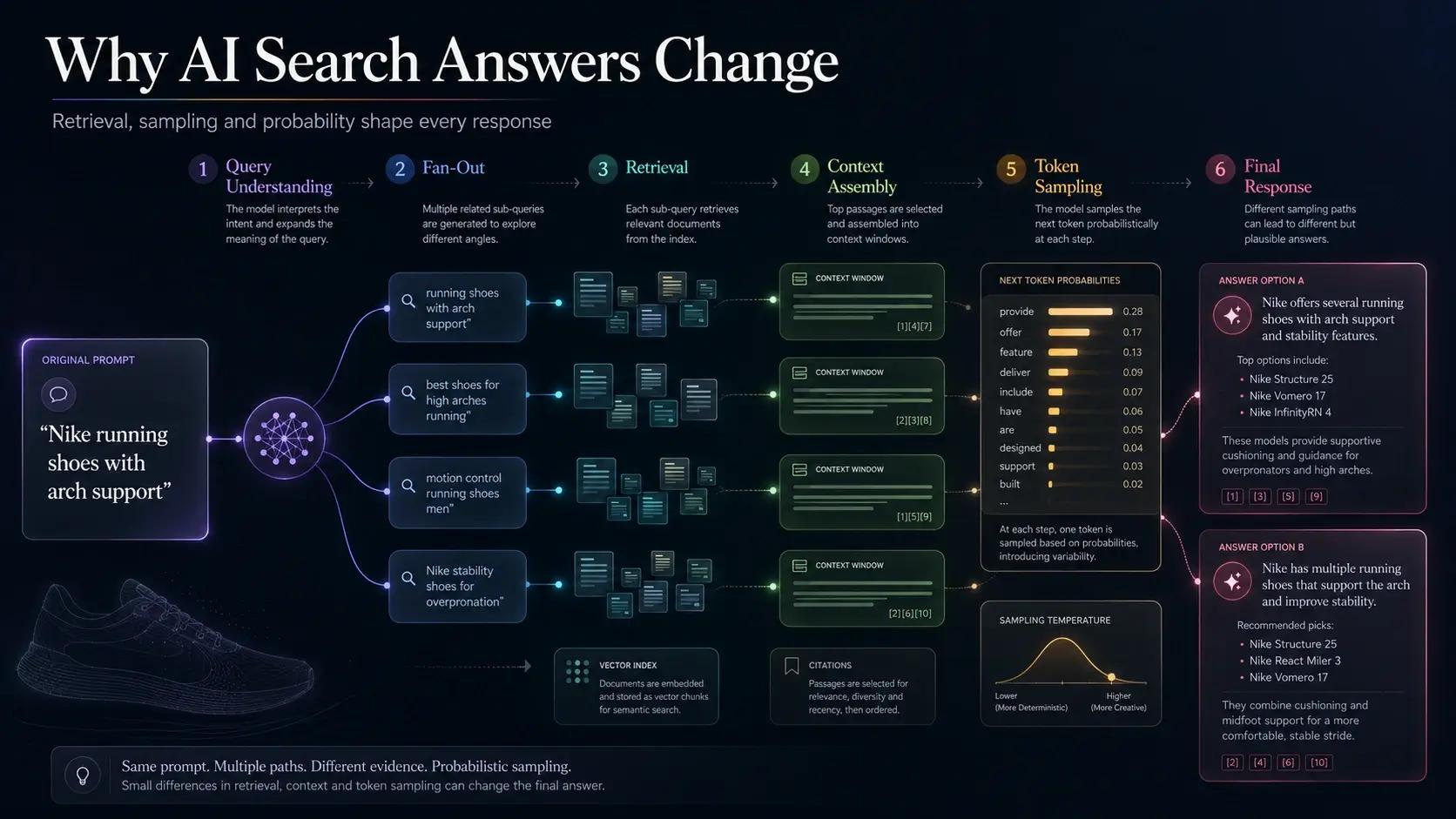
Why the Same Query Returns Different Answers: Randomness in AI Search
There is a comforting myth about AI search. It says that somewhere underneath it all sits a ranking, and if you play it right, you climb. There is no ranking. Between the question you ask and the answer you get sit six distinct stages: parsing, fan-out, retrieval, assembly, sampling, and citation. Each one introduces randomness on purpose, not by accident, and the variance compounds as it moves down the pipeline. This is a walk through all six, traced end to end through a single real query, so you can see exactly where the randomness enters, and why the whole idea of holding a fixed position falls apart.

Google Search I/O 2026: When Google Says SEO, Bing Shows What Search Is Becoming
Google’s Search I/O message is designed to reassure publishers that SEO still matters. Bing’s writing is more revealing: the search index is no longer just a system for ranking pages, it is becoming infrastructure for answers, citations, grounding and agentic decisions. The practical lesson is not to chase AEO theatre or machine-facing gimmicks, but to build content that can be crawled, trusted, extracted, cited and carried into an AI answer without losing its meaning.

Google's AI Optimisation Guide: The Funeral of AEO Theatre
Google's official AI Search guidance confirms that AI Overviews and AI Mode are grounded in core Search systems. Here is what matters, what does not, and why AEO theatre is not strategy.