If there is ever a so often overlooked reality in the modern digital gold rush, it is the simple, unvarnished truth of how things actually work. The inability for people to see outside the box, the fog, the pre-sold, broken programming that spawned the industry we know today as SEO, is now birthing its mutant offspring. They call it Generative Engine Optimisation, or GEO.
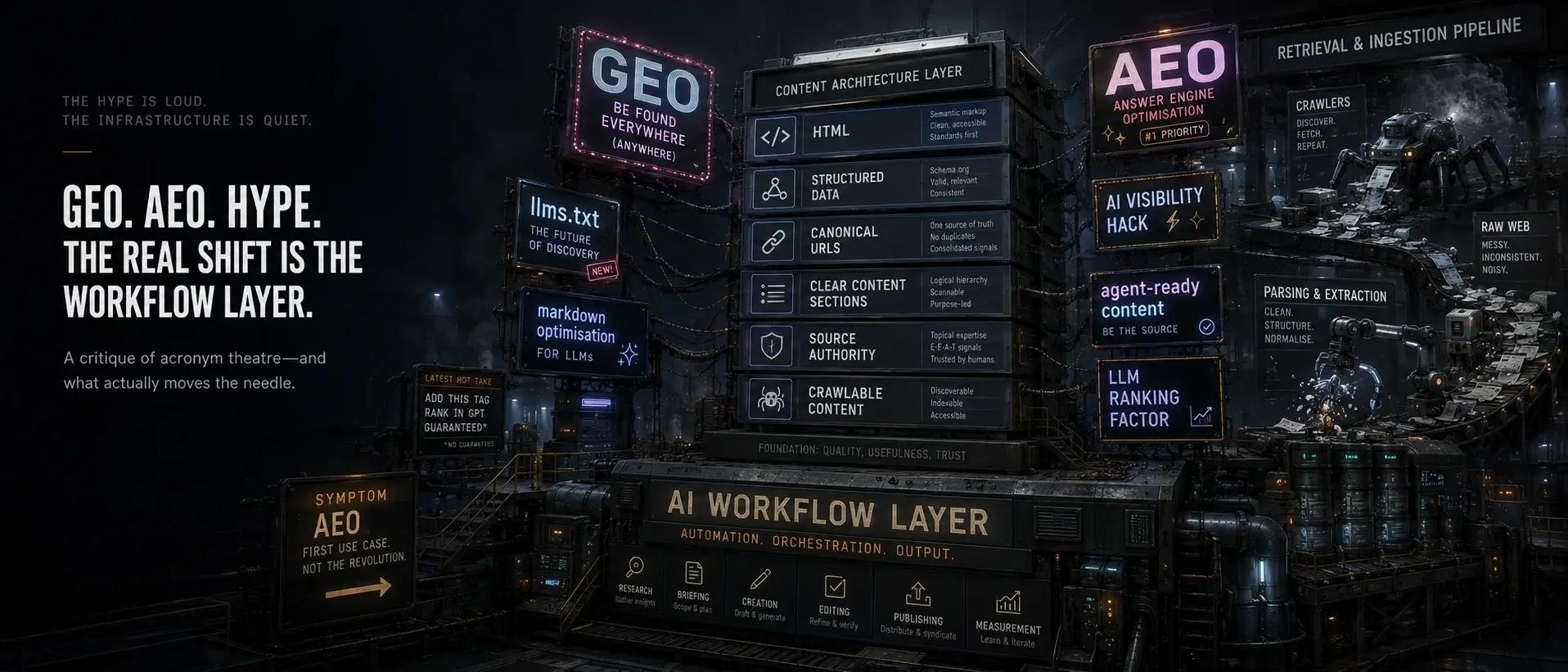
But here is the thing that most people get backwards: AEO is not the cause of this shift. It is the symptom. It is the first prominent place where AI and automation got pointed at marketing, and now everyone is treating it like it is the strategic driver rather than the first obvious target.
You have probably seen the LinkedIn posts. The self-proclaimed gurus telling you that to survive the AI apocalypse, you must 'serve large language models the language they understand'. They preach the gospel of .md files and llms.txt, promising that if you just format your site correctly, the AI overlords will bless you with traffic. It is a compelling narrative. It is also, fundamentally, bollocks.
The entire GEO sector, in its rush to invent a new acronym to bill you for, ignores the basic architectural truth of how these models interact with the web. More importantly, they have the causality completely backwards.
Automation is the Real Story. AEO Is Just the First Use Case
AI workflows and content automation were coming whether AEO existed or not. The technology does not care about your marketing lexicon. If AEO had never become a concept, the same automation would still be happening now. The industry would simply be framing it through SEO instead.
So why did AEO become the poster child?
Two reasons.
First, AEO is currently perceived as more strategically urgent than SEO. Second, it has become the shiny new budget line every marketing team feels obliged to justify. That does not mean AEO is driving the shift. It means AEO happened to be the first obvious place where automation could be pointed.
Every marketing team is trying to work out what AEO means. Every agency is launching an AEO service. Every vendor is selling an AEO solution. That creates the perfect conditions for automation to walk in wearing a new badge and pretend it was invited by strategy.
But the automation is not happening because of AEO.
AEO is simply the first thing AI got pointed at.
It is not the engine of the shift. It is the first visible use case, and there is a very big difference.
The Mistake Everyone is Making
The mistake is treating AEO as the cause rather than the symptom. If you think AEO programs are causing this shift toward automation and AI-driven workflows, you have causality backwards. AEO is just the first prominent example of the shift. AEO is not the engine of the shift. It is the Trojan horse that let the shift walk through the gates.
This matters because it changes what you should actually be paying attention to. If you focus on 'optimising for AEO', you are optimising for the first use case. But the real game is automation, workflows, and AI-driven content at scale. AEO is just the frame that made it acceptable to talk about. We are in early days of content at scale, major brands have already lost with poor pSEO strategy. The future of workflows is "quality over quantity" It is that methodology that makes Word Presto such a valuable component in content production.
The Myth of the AI Handshake
Now, layered on top of this confusion about causality, the GEO industry has invented another layer of mythology. The current convention imagines a sophisticated dance. A model introspects your headers, follows a rel=alternate tag, or sends a polite Accept: text/markdown header, whispering, 'I am an LLM, serve me the clean version'.
In practice, a retrieval pipeline typically fetches HTML and converts it internally, exactly the same as any standard web crawler. There is no magical step where the model negotiates format or identifies itself to coax markdown out of a server.
When an LLM retrieves a page for an ordinary question, it is just asking for a URL. The Accept header and the user-agent string, those are set by the fetching infrastructure, not by the model composing a request. The model itself cannot hand-craft an Accept: text/markdown or an LLM-identifying user-agent to force a content-negotiating server to swap formats. It is not a lever available at the layer where it would actually matter.
The Data Behind the Delusion
Recent empirical research lays this bare. When common AI agents were tested to see which ones actually request markdown via content negotiation, the results were telling [1].
| AI Agent | Requests Markdown? | Accept Header Sent |
|---|---|---|
| Claude Code | Yes | Accept: text/markdown, text/html, */* |
| Cursor | Yes | Accept: text/markdown,text/html... |
| OpenCode | Yes | Accept: text/markdown;q=1.0... |
| OpenAI Codex | No | Accept: text/html... |
| Gemini CLI | No | Accept: */* |
| GitHub Copilot | No | Accept: text/html... |
| Windsurf | No | Accept: */* |
Only three out of seven major agents even bother to ask for markdown. Giants like OpenAI Codex and Gemini CLI do not negotiate at all. They pull the HTML, warts and all, and process it on their end.
So, when a GEO vendor tells you to restructure your entire site architecture to serve markdown because 'that is what the AI wants', they are selling you a solution for a problem that only a fraction of the ecosystem even recognises.
- Restructuring your site for markdown when only 3 of 7 agents request it
- Treating content negotiation as a ranking factor when it is purely an efficiency measure
- Spending money on GEO when the foundational architecture is still aspirational
The Cost is Theirs, Not Yours
Why are companies like Cloudflare and Vercel pushing for markdown conversion? Because HTML is expensive for them.
An AI agent looking at a standard web page sees 180,000 tokens of navigation bars, footers, and div soup [1]. This burns through their context window and costs them processing power. Cloudflare noted an 80% token reduction when serving markdown instead of HTML [2].
This is an efficiency problem for the AI companies, not a visibility problem for you. Serving markdown makes it cheaper for Claude or Cursor to read your site. It does not magically guarantee they will choose your content over a competitor's. The GEO industry has taken an infrastructure cost-saving measure and repackaged it as a ranking factor.
The GEO industry has confused infrastructure efficiency with visibility. They are selling you a solution to a problem that only affects the AI companies' bottom line, not yours.
The Real Architecture Truth
This is the part that is easy to over-romanticise about llms.txt and markdown alternates. Sites that want models to get markdown generally have to do it by content-negotiating on a user-agent they recognise, or by publishing markdown at discoverable URLs and hoping the model fetches those.
But the vast majority of the time, the 'I am an LLM, serve me the clean version' handshake simply does not happen automatically.
Business is not easy, well that is what we are told, although the essence of business is not simply connecting people with their needs and wants based on the latest acronym. If you want to show up in AI search, you need to focus on what actually matters, which is primary source-verified best practices [3].
- Optimise your content structure with natural language URLs, structured data, and clearly delineated sections
- Demonstrate E-E-A-T signals. Experience, Expertise, Authoritativeness, and Trustworthiness are built into content, not hacked with a `.md` file
- Canonicalise your URLs. Ensure every page has exactly one canonical URL
Do not let the culture soup of LinkedIn gurus convince you to spend the bones of your ass on GEO. Build a solid foundation, write for humans, and let the AI sort out its own token costs. The reality is far less glamorous than the pitch, but it is the only foundation worth building on.
And more importantly, stop thinking about AEO as the driver of change. It is not. It is just the first place where the real shift—automation and AI workflows—got pointed at. The shift was coming regardless. AEO is just the frame that made it acceptable to talk about.
References
[1] Checkly. (2026). The Current State of Content Negotiation for AI Agents. https://www.checklyhq.com/blog/state-of-ai-agent-content-negotation/
[2] Cloudflare. (2026). Introducing Markdown for Agents. https://blog.cloudflare.com/markdown-for-agents/
[3] Patrick Ryall. SEO Best Practices. https://patrickryall.com/seo-best-practices