

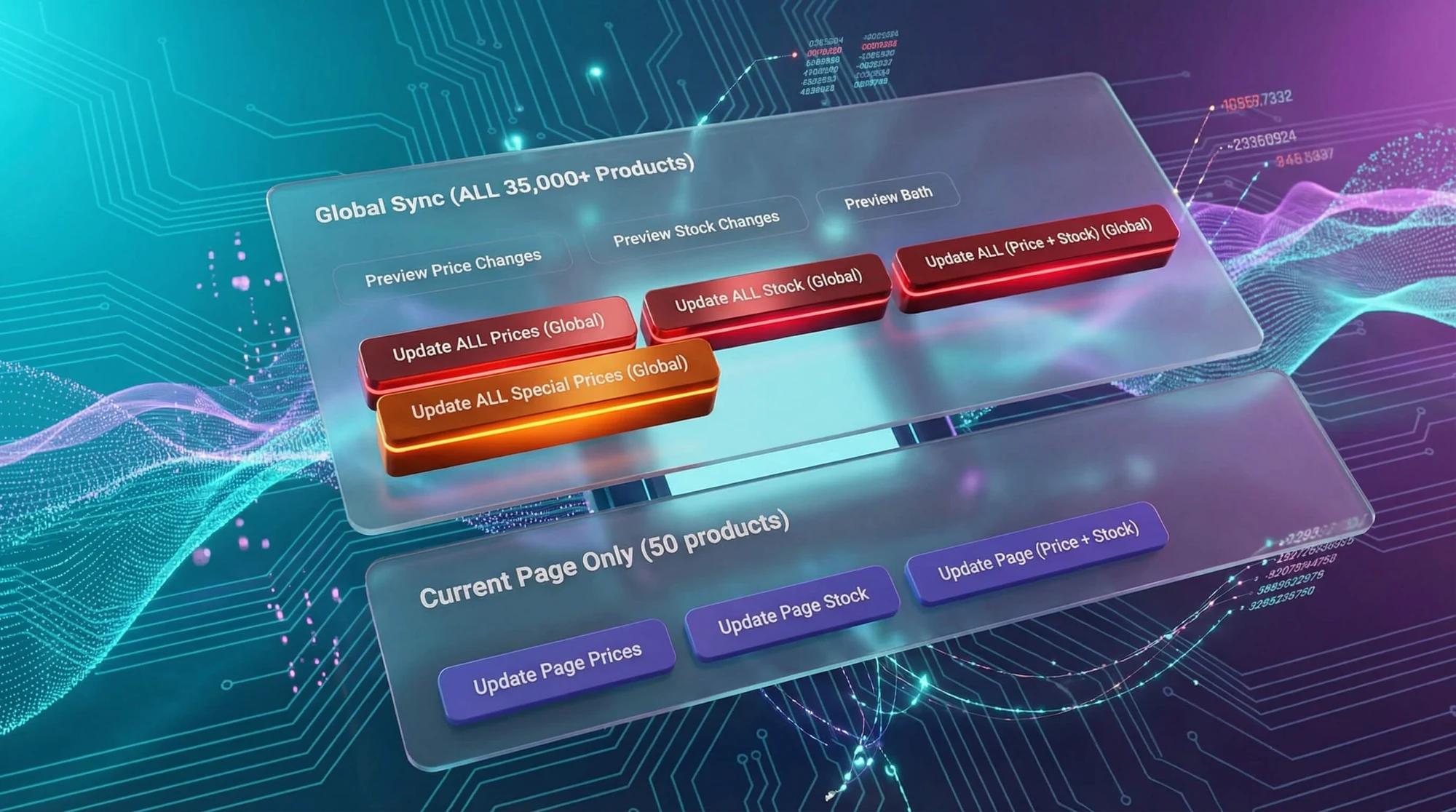
When Shopify Apps Stop Working Like They Should
You know that moment when your business quietly outgrows the tools that got you this far?
At first, everything’s fine. A couple of suppliers. A few thousand SKUs. An app from the Shopify App Store that mostly does the job. You tell yourself, “This’ll do for now.”
Until it doesn’t.
Suddenly you’re juggling multiple feeds. Different formats. Different update schedules. One supplier sends clean XML. Another sends… well, something that technically counts as data. Prices drift. Stock goes out of sync. Variants don’t line up. And before you know it, you’re running an e-commerce operation held together by spreadsheets and crossed fingers.
The Real Problem Isn’t Importing Data
Importing products into Shopify is easy. Keeping them accurate isn’t.
Franklin Motors works with multiple suppliers, each with their own idea of how product data should look. Sizes, colours, variants, pricing rules, VAT, special order flags… none of it lines up neatly. And Shopify apps? They tend to fall into two camps.
Too basic.
Or trying to solve every problem for everyone.
Neither worked.
The apps we tested could pull in CSVs, sure. But they couldn’t intelligently group variants. They didn’t understand Shopify metaobjects. They couldn’t preview price changes properly. And they definitely didn’t give the team confidence that hitting “sync” wouldn’t break something important.
That’s the bit people don’t talk about enough …………. trust.
If you don’t trust your tools, you end up doing everything manually anyway.
So We Built Exactly What Was Needed
Not a product. Not an app-store download. Just a tool built for the job at hand.
The idea was simple. Bring all supplier data into one place. Clean it up. Make sense of it. Flag problems early. And crucially, keep a human in control before anything goes live.
Nothing flashy. Just calm, deliberate control.
The Feed Manager sits alongside Shopify, pulling in data from suppliers like Zodiac and Pando Moto, storing it properly, and showing the team exactly what’s changing and why. No guesswork. No surprises.
What It Actually Does (In Plain English)
It pulls in supplier feeds daily and keeps a history, so you can see what changed and when.
It groups variants intelligently, so six sizes of the same jacket don’t become six separate products by mistake.
It handles Shopify’s variant switchers properly, without hours of manual metaobject setup.
It compares feed prices and stock against Shopify side by side, so you can spot problems instantly instead of after a customer emails.
It flags broken data before it causes damage. Missing fields. Bad images. Duplicate SKUs. The boring stuff that causes big headaches later.
And when it’s time to push updates, you see a preview first. Always. Because blind automation is how stores get burned.
Why This Matters More Than People Admit
Shopify’s ecosystem is brilliant. But it’s built around averages.
As soon as your business becomes a little specific …………. specialist products, multiple suppliers, real operational complexity …………. those averages stop working in your favour.
You can hack around it with scripts. Or spreadsheets. Or manual checks every morning. Plenty of teams do.
But there’s a point where the effort of working around generic tools costs more than building the right one.
Custom tools are something many businesses could consider.
This Isn’t About “Custom for the Sake of It”
Custom software isn’t automatically better. For many stores, an off-the-shelf app is exactly the right choice.
But if you’re constantly bending your workflow to fit someone else’s product, that’s a signal. If data accuracy really matters. If one bad sync can cost you real money. If your processes keep evolving.
Then building something that fits how you actually work starts to make a lot of sense.
The Bigger Picture
The Feed Manager isn’t special because of the tech stack or the features list. It works because it mirrors real operations. Real edge cases. Real frustrations.
Same approach we’ve taken elsewhere. Understand the mess first. Then design something that removes it.
If you’re reading this thinking, “Yeah… this feels uncomfortably familiar,” you’re not alone. A lot of mature Shopify businesses are quietly in the same place.
Sometimes the answer isn’t a better app.
Sometimes it’s building the tool you wish already existed.