
TL/DR: 80% of consumers search for local businesses online, but most Irish businesses are invisible in local search results. The foundation is Google My Business - claim it, complete every section, add photos, and manage reviews. Then optimise your website with local keywords, create location-specific content, build local citations, and engage with your community online. Local SEO isn't about gaming Google - it's about serving your local community better.
Key Takeaway: Local SEO success comes from building a strong, authentic local presence that search engines can easily understand and recommend.
When Siobhan opened her physiotherapy clinic in Drogheda, she assumed that having a website would be enough for people to find her online. After six months of disappointing results, she discovered the harsh reality: her website was buried on page 47 of Google search results. Meanwhile, her competitors, who offered inferior services, were appearing at the top of search results and capturing all the new patients.
"I couldn't understand it," Siobhan explains. "I had a beautiful website, great reviews from existing patients, and years of experience. But when people searched for 'physiotherapist Drogheda,' I was nowhere to be found."
Siobhan's story is frustratingly common among Irish small businesses. They invest in websites, provide excellent services, and build strong reputations in their communities, yet remain invisible to potential customers searching online. The missing piece is local SEO - the practice of optimising your online presence to appear in local search results.
The good news is that local SEO isn't as complicated as many business owners believe. With the right approach and consistent effort, small businesses can dramatically improve their visibility in local search results. More importantly, the businesses that get local SEO right often see a significant increase in high-quality enquiries from customers who are ready to buy.
Why Local SEO Matters More Than Ever for Irish Businesses
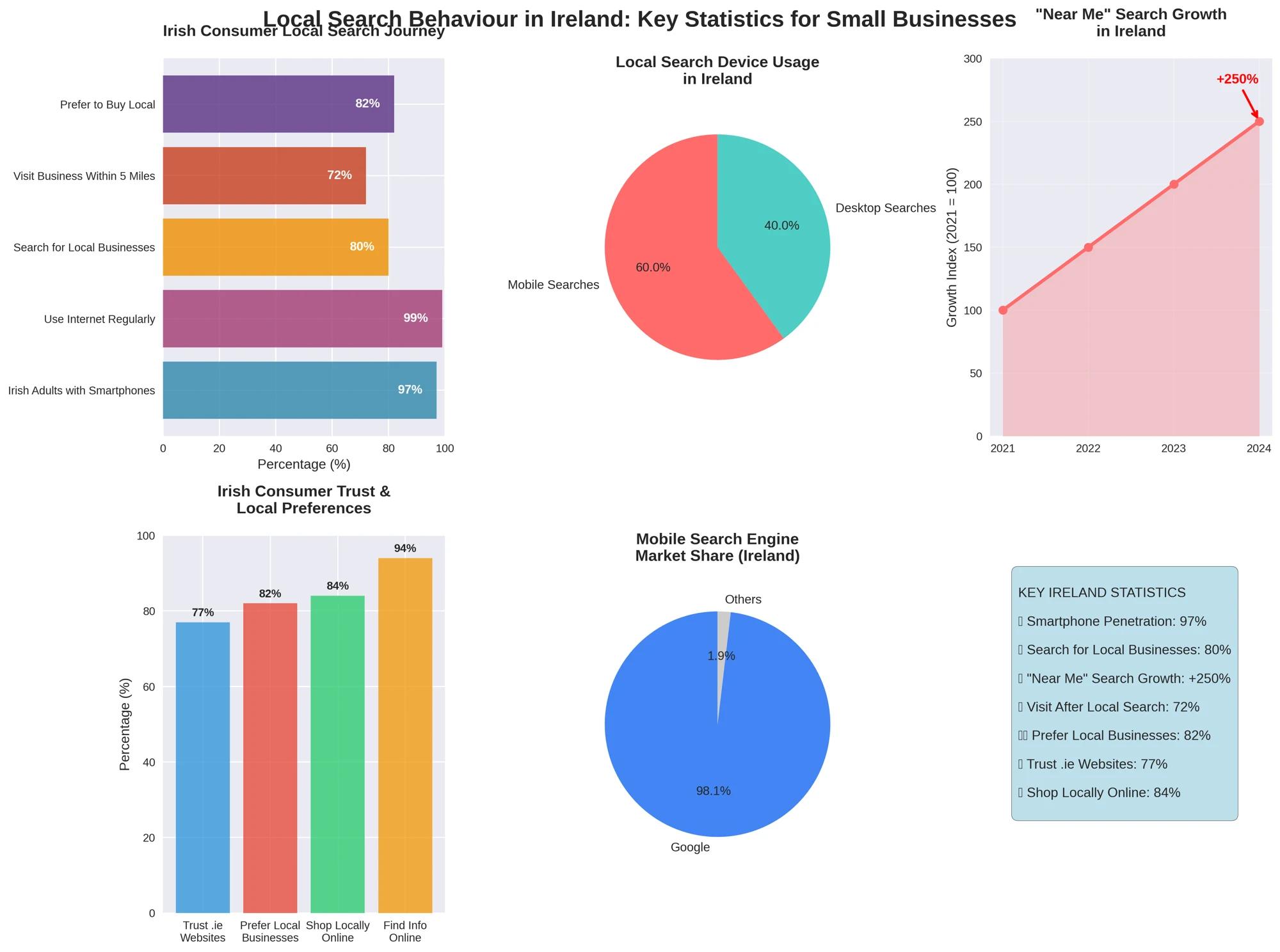
The statistics around local search behaviour are compelling and show why local SEO has become essential for small businesses. Over 80% of consumers use search engines to find local businesses, and 72% of those who conduct a local search visit a store within a five-mile radius of their location.
For Irish businesses, these numbers are even more significant because of our relatively small geographic market. When someone in Cork searches for "accountant near me," they're not looking for someone in Dublin. They want a local professional they can meet face-to-face, someone who understands the local business environment, and someone who comes recommended by their community.
The challenge is that Google receives millions of local searches every day, and only a handful of businesses appear at the top of results for any given search. The businesses that appear first aren't necessarily the best or most established - they're the ones that have optimised their online presence for local search.
Consider the financial impact: businesses that appear in the top three local search results receive 60% of all clicks from local searches. If you're not in those top positions, you're missing out on the majority of potential customers who are actively searching for your services.
The opportunity is particularly significant for Irish businesses because many are still not taking local SEO seriously. This means that businesses that do invest in local SEO often see dramatic results simply because they're competing against businesses that aren't optimising at all.
Understanding How Local Search Works
Before diving into specific tactics, it's important to understand how Google determines which businesses to show for local searches. Google's local search algorithm considers three main factors: relevance, distance, and prominence.
Relevance refers to how well your business matches what someone is searching for. If someone searches for "Italian restaurant Dublin," Google looks for businesses that are clearly identified as Italian restaurants in Dublin.
Distance is straightforward - Google considers how close your business is to the person searching or to the location mentioned in their search. This is why someone searching for "plumber" will see different results than someone searching for "plumber Galway."
Prominence is Google's measure of how well-known and reputable your business is. This is determined by factors like online reviews, mentions across the web, and the overall authority of your website.
Understanding these factors helps explain why some businesses rank well in local search while others don't. It's not enough to simply exist online - you need to clearly communicate your relevance, establish your local presence, and build your reputation across multiple online platforms.
The Foundation: Getting Your Google My Business Right
Google My Business is the single most important factor in local SEO success, yet many Irish businesses either haven'tclaimed their listing or have incomplete, outdated information. This is like having a shop but forgetting to put up a sign - potential customers simply can't find you.
Claiming and Verifying Your Listing
The first step is to claim your Google My Business listing. Even if you've never created one, Google may have automatically generated a listing for your business based on information found online. Search for your business name on Google Maps to see if a listing already exists.
If a listing exists, claim it by clicking "Own this business?" and following the verification process. If no listing exists, create one by going to business.google.com and following the setup process. Google will verify your business by sending a postcard to your business address with a verification code.
This verification process is crucial because only verified businesses can appear in Google's local search results. Don't try to rush this step - wait for the postcard and complete the verification properly.
Optimising Your Business Information
Once your listing is verified, the real work begins. Complete every section of your Google My Business profile with accurate, detailed information. This includes your business name, address, phone number, website, hours of operation, and business category.
Choose your business category carefully. Google uses this to understand what your business does and when to show it in search results. Select the most specific category that accurately describes your primary business activity. You can add additional categories, but your primary category should be the most important one.
Write a compelling business description that includes relevant keywords naturally. Instead of "We provide excellent customer service," try "Family-run plumbing business serving Waterford and surrounding areas for over 15 years, specialising in emergency repairs and bathroom renovations."
Add high-quality photos of your business, products, services, and team. Businesses with photos receive 42% more requests for directions and 35% more click-throughs to their websites. Include photos of your storefront, interior, products, services in action, and team members.
Managing Reviews and Responses
Online reviews are crucial for local SEO success and customer trust. Businesses with positive reviews rank higher in local search results and are more likely to be chosen by potential customers. However, many Irish businesses are uncomfortable asking for reviews or don't know how to manage them effectively.
Develop a systematic approach to requesting reviews from satisfied customers. This doesn't mean pestering every customer, but rather identifying your happiest customers and politely asking them to share their experience online. A simple email or text message after completing a job can be very effective.
Respond to all reviews, both positive and negative. Thank customers for positive reviews and address any concerns raised in negative reviews professionally and constructively. This shows potential customers that you care aboutcustomer satisfaction and are willing to address problems when they arise.
A Galway-based restaurant increased their local search rankings significantly, simply by implementing a review management system. They started asking satisfied customers to leave reviews, responded to all feedback, and saw their average rating increase from 3.8 to 4.6 stars within six months. More importantly, their visibility in local search results improved dramatically.
Optimising Your Website for Local Search
While Google My Business is the foundation of local SEO, your website plays a crucial supporting role. Google looks at your website to understand more about your business and to verify the information in your Google My Business listing.
Local Keywords and Content
Include location-specific keywords naturally throughout your website content. This means mentioning the cities, towns, and areas you serve in your page titles, headings, and content. However, avoid keyword stuffing; the mentions should feel natural and provide value to readers.
Create location-specific pages if you serve multiple areas. A cleaning service that operates in both Cork and Limerick should have separate pages optimised for each location, with unique content that speaks to the specific needs and characteristics of each area.
Write content that demonstrates your local expertise and connection to the community. Blog posts about local events, partnerships with other local businesses, or insights into local market conditions all help establish your local relevance.
Technical SEO Basics
Ensure your website loads quickly and works well on mobile devices. Google considers page speed and mobile-friendliness as ranking factors, and these are particularly important for local searches since many people search for local businesses on their phones.
Include your business name, address, and phone number (NAP) on every page of your website, typically in the footer. This information should be identical to what appears in your Google My Business listing and other online directories.
Add structured data markup to help search engines understand your business information. This technical step can help your business appear in rich snippets and other enhanced search results. While this might require help from a web developer, the impact on local search visibility can be significant.
Building Local Citations and Online Presence
Citations are mentions of your business name, address, and phone number on other websites. These citations help Google verify your business information and understand your local relevance. The quality and consistency of your citations can significantly impact your local search rankings.
Directory Listings and Local Websites
Start with major Irish business directories like Golden Pages, Yelp Ireland, and industry-specific directories relevant to your business. Ensure your business information is consistent across all listings - any discrepancies can confuse search engines and hurt your rankings.
Look for local directories and websites where your target customers might search for businesses. This could include local chamber of commerce websites, community directories, or local newspaper websites that feature business listings.
Don't overlook industry-specific directories. A solicitor should be listed in legal directories, a restaurant should be in food and dining directories, and a tradesperson should be in relevant trade directories.
Building Relationships with Local Websites
Develop relationships with other local businesses and organisations that might mention or link to your business online. This could include suppliers, customers, business partners, or community organisations you support.
Participate in local events and ensure they're covered on local websites and social media. Sponsor local sports teams, participate in charity events, or host community workshops. These activities often result in online mentions that boost your local SEO.
Consider writing guest articles for local publications or websites. A financial advisor might write about tax planning for a local business magazine, or a fitness trainer might contribute to a community health website. These articles establish expertise while building valuable local connections.
The Content Strategy That Builds Local Authority
Creating regular, locally-focused content is one of the most effective ways to improve your local search rankings while providing genuine value to your community. This content strategy should focus on topics that matter to your local audience and demonstrate your expertise in serving local customers.
Local Market Insights and Trends
Share insights about trends affecting your local market. A Cork-based estate agent might write about property market trends in different Cork neighbourhoods, while a Galway restaurant owner might discuss seasonal ingredient availability from local suppliers.
This type of content serves multiple purposes: it demonstrates your local expertise, provides value to your community, and naturally includes local keywords that help with search rankings.
Community-Focused Content
Write about local events, news, and issues that affect your customers. This doesn't mean becoming a news website, but rather commenting on local developments from your business perspective.
A Limerick-based accountant might write about how new local business incentives affect small business owners, or a Dublin-based fitness trainer might discuss how to stay active during Dublin's winter weather.
Customer Success Stories and Case Studies
Share stories about how you've helped local customers, with their permission. These stories are powerful for both SEO and customer trust because they demonstrate real results while naturally including local keywords and references.
A Waterford-based marketing consultant increased her local search visibility significantly by publishing monthly case studies about helping local businesses grow. Each case study naturally included location-specific keywords while providing valuable insights for other local business owners.
Measuring and Improving Your Local SEO Performance
Local SEO is not a one-time effort but an ongoing process that requires regular monitoring and adjustment. Understanding how to measure your performance helps you identify what's working and where you need to focus your efforts.
Key Metrics to Track
Monitor your Google My Business insights to see how many people are finding your business through search, how many are requesting directions, and how many are visiting your website. These metrics give you a clear picture of your local search performance.
Track your rankings for important local keywords using tools like Google Search Console or local SEO tracking tools. Focus on keywords that are most relevant to your business and most likely to drive qualified traffic.
Monitor your online reviews and ratings across all platforms. Your review profile affects both your search rankings and customer decision-making, so it's important to track trends and address any issues quickly.
Making Data-Driven Improvements
Use your performance data to identify opportunities for improvement. If you're getting lots of map views but few website visits, your Google My Business listing might need better photos or a more compelling description. If you're ranking well for some keywords but not others, you might need to create more content around those topics.
Test different approaches and measure the results. Try different business descriptions, add new photos, or create content around different local topics. Local SEO responds well to experimentation and continuous improvement.
Common Local SEO Mistakes Irish Businesses Make
Understanding common mistakes helps you avoid pitfalls that could hurt your local search performance. Many of these mistakes are easy to make but can significantly impact your visibility.
Inconsistent Business Information
One of the most common mistakes is having different versions of your business name, address, or phone number across different websites. Even small differences, like "St." versus "Street" or including or excluding suite numbers, can confuse search engines.
Conduct regular audits of your business information across all online platforms and correct any inconsistencies immediately. This includes your website, Google My Business, social media profiles, and directory listings.
Neglecting Customer Reviews
Many businesses either don't actively seek reviews or don't respond to the reviews they receive. Both approaches missopportunities to improve local search rankings and build customer trust.
Develop a systematic approach to review management that includes requesting reviews from satisfied customers and responding professionally to all reviews, both positive and negative.
Focusing Only on Google
While Google is the most important search engine for local SEO, don't ignore other platforms where your customers might search for businesses. This includes Bing, Apple Maps, and industry-specific platforms.
Maintain consistent information across all platforms and actively manage your presence wherever your customers might look for businesses like yours.
The Long-Term Local SEO Strategy
Local SEO success requires patience and consistency. Unlike paid advertising, which can deliver immediate results, local SEO builds momentum over time. However, the results are often more sustainable and cost-effective than other marketing approaches.
Focus on building a strong foundation with accurate business information, positive customer reviews, and locally relevant content. Then consistently work to strengthen your local online presence through community involvement, content creation, and relationship building.
Remember that local SEO is ultimately about serving your local community better. When you focus on providing genuine value to local customers and building real relationships in your community, the SEO benefits follow naturally.
The Irish businesses that succeed with local SEO are those that understand this fundamental truth: local SEO is not about gaming search engines, but about building a strong, authentic local presence that search engines can easily understand and recommend to local searchers.
Start with the basics, be consistent in your efforts, and focus on serving your local community well. The search rankings will follow, and more importantly, you'll build the kind of local reputation that sustains long-term business success.