

If you're a small business owner in Ireland, chances are you've invested time, money, and hope into a website that simply isn't delivering the results you expected. You're not alone, and more importantly, you're not stuck with a website that doesn't work for your business.
The truth is, most small business websites fail not because they're poorly designed, but because they're missing fundamental elements that actually drive business results. After analysing hundreds of successful small business websites and looking at the data available at our fingertip, we've identified the five most common problems and their surprisingly simple solutions.
The Real Cost of a Website That Doesn't Work
In Ireland, where 84% of consumers research businesses online before making a purchase decision, your website often serves as the first impression of your business. When that first impression falls flat, you're not just losing potential customers, you're actively pushing them towards your competitors.
Research shows that visitors form an opinion about your website in just 50 milliseconds. That's faster than the blink of an eye. In that split second, they're deciding whether your business looks trustworthy, professional, and worth their time. If your website fails this crucial test, all your other marketing efforts become significantly less effective. 2006 study by Dr. Gitte Lindgaard and her team at Carleton University in Ontario
The financial impact is real and measurable. Small businesses with optimised websites typically see 2-3 times more enquiries than those with poorly performing sites. For a local service business, that could mean the difference between struggling to find customers and having a healthy pipeline of prospects.
Problem 1: Your Website Takes Forever to Load (And Why That's Killing Your Business)
Website loading speed matters, but let's talk realistic numbers. The average website takes 8.6 seconds to load on mobile devices, and many small business websites are even slower. Google research shows that bounce rates increase significantly as loading times increase, but the real opportunity isn't achieving some perfect 2-second target - it's being faster than your slow-loading competitors. If your website loads in 4-5 seconds while others in your industry take 10+ seconds, you'll have a genuine competitive advantage. (Think with Google, Page Load Time Statistics).
The problem is particularly acute for small businesses because many website builders and hosting providers market themselves as "easy" solutions without mentioning the performance trade-offs. You might have chosen a platform because it was simple to use, only to discover that your beautiful website crawls along at a snail's pace.
The Simple Fix: Optimise for Speed
The good news is that improving your website's loading speed doesn't require technical expertise or a complete rebuild. Here are three immediate actions you can take:
First, compress your images. Large image files are the most common culprit behind slow websites. Tools like TinyPNG or Squoosh can reduce your image file sizes by 70-80% without any visible quality loss. If you're using WordPress, plugins like Smush can automate this process.
Second, choose a reliable hosting provider. If you're currently using the cheapest hosting option you could find, it's likely costing you more in lost business than you're saving in hosting fees. Irish businesses often see significant improvements by switching to providers like Blacknight or Host Ireland, which offer servers located closer to your target audience.
Third, enable caching. This technical-sounding solution is actually quite simple to implement. Caching stores a version of your website that loads faster for returning visitors. Most website platforms offer caching plugins or built-in options that you can enable with a few clicks.
The impact of these changes can be dramatic. Imagine a consultancy whose website takes 8 seconds to load, most visitors give up and leave. But if they could get that loading time down to 2 seconds, they'd likely see a significant increase in enquiries, possibly 50-60% more people actually staying long enough to read their content and get in touch. The investment for these improvements is typically modest, often less than €1000 and a few hours of work.
Problem 2: Your Website Looks Terrible on Mobile (And Most of Your Customers Are on Their Phones)
We all know everyone is buried in their phones, while it can be problematic crossing the road, for business it is an opportunity. Mobile internet usage now accounts for over 60% of all web traffic, yet many small business websites still treat mobile as an afterthought.
The problem isn't just that your website looks cramped on a small screen. Mobile users behave differently from desktop users. They're often looking for specific information quickly - your phone number, opening hours, or location. If they can't find this information easily on their phone, they'll simply call your competitor instead.
The Simple Fix: Think Mobile First
Transforming your website for mobile doesn't mean starting from scratch. It means prioritising the mobile experience in every decision you make about your website.
Start with your most important information. Your phone number should be clickable and prominently displayed at the top of every page. Your address should link directly to Google Maps. Your opening hours should be immediately visible without scrolling.
Next, simplify your navigation. Complex dropdown menus that work well on desktop become frustrating obstacles on mobile. Consider a simple, clean menu with your most important pages clearly listed. Many successful Irish businesses use a "hamburger menu" (those three horizontal lines) that expands to show navigation options.
Pay special attention to your contact forms. Nothing frustrates mobile users more than trying to fill out a form that's difficult to use on a small screen. Keep forms short, use large input fields, and make sure the submit button is easy to tap.
Test your website regularly on your own phone. Better yet, ask friends and family to try finding specific information on your site using their phones. You'll quickly discover pain points that aren't obvious when viewing your site on a computer.
Problem 3: Visitors Can't Figure Out What You Actually Do (The Clarity Problem)
This might be the most common problem we see with small business websites, and it's often the hardest for business owners to recognise. You know your business inside and out, so your website makes perfect sense to you. But to a first-time visitor, your site might be confusing, vague, or unclear about what you actually offer.
The problem often stems from trying to be everything to everyone. In an effort not to exclude potential customers, many businesses end up with websites that don't clearly communicate their core value proposition. Visitors leave because they can't quickly understand how your business can help them.
The Simple Fix: Pass the Five-Second Test
Your website should pass what we call the "five-second test." A visitor should be able to land on your homepage and within five seconds understand three things: what you do, who you do it for, and why they should choose you over your competitors.
Start with your headline. This is the first thing visitors see, and it should clearly state what your business does. Instead of clever taglines or vague statements, use clear, descriptive language. "Award-winning web design for Irish small businesses" is much more effective than "Crafting digital experiences."
Create a clear value proposition. This should be a simple statement that explains the main benefit customers get from working with you. Making simple changes can increase conversion rates by as much as 45% simple headline changes into solution-based, "Professional accounting services" to "We help Irish small businesses save money on taxes and avoid costly mistakes."
Use specific examples and case studies. Instead of saying you provide "excellent customer service," share a brief story about how you helped a specific customer solve a problem. Irish consumers particularly value social proof and recommendations from other local businesses.
Eliminate jargon and industry speak. Write as if you're explaining your business to a friend who knows nothing about your industry. If you must use technical terms, explain them in simple language.
Problem 4: Your Website Doesn't Show Up in Google (The Invisible Business Problem)
You could have the most beautiful, fast-loading, mobile-friendly website in Ireland, but if people can't find it when they search for your services, it might as well not exist. This is where local SEO becomes crucial for small businesses.
Many business owners assume that simply having a website means they'll appear in search results. Unfortunately, that's not how Google works. Without proper optimisation, your website might be buried on page 10 of search results, where virtually no one will ever find it.
The challenge is particularly acute for local businesses. When someone in your area searches for the services you provide, you want to be among the first results they see. This isn't just about vanity - it's about survival in an increasingly competitive marketplace.
The Simple Fix: Optimise for Local Search
Local SEO might sound complicated, but the fundamentals are straightforward and can make a dramatic difference in your visibility.
Start with Google My Business. This free tool is essential for any local business. Claim your listing, fill out every section completely, and keep your information updated. Add photos of your business, products, or team. Encourage satisfied customers to leave reviews. A complete Google My Business profile can significantly improve your chances of appearing in local search results.
Include location-specific keywords on your website. If you're a plumber in Cork, make sure your website mentions "Cork plumber" or "plumbing services in Cork" naturally throughout your content. Don't stuff keywords unnaturally, but do make it clear where you're located and what areas you serve.
Create location-specific content. Write blog posts about local events, news, or issues related to your industry. A Limerick-based fitness trainer might write about "Best running routes in Limerick" or "Staying fit during Irish winters." This type of content helps establish your local relevance to search engines. To make the website even more sticky, she might take the time to create running routes in Google Maps that people can use.
Ensure your business information is consistent across the web. Your business name, address, and phone number should be identical on your website, Google My Business, social media profiles, and any online directories. Inconsistent information confuses search engines and can hurt your rankings.
Build local connections online. Partner with other local businesses for cross-promotion. Join local business directories. Participate in community events and share about them on your website. These activities create the kind of local signals that search engines use to determine relevance for local searches.
Problem 5: Your Website Doesn't Convert Visitors into Customers (The Conversion Problem)
This is perhaps the most frustrating problem of all. You're getting visitors to your website, but they're not taking action. They're not calling, emailing, or making purchases. Your website has become a digital brochure rather than a business-generating tool.
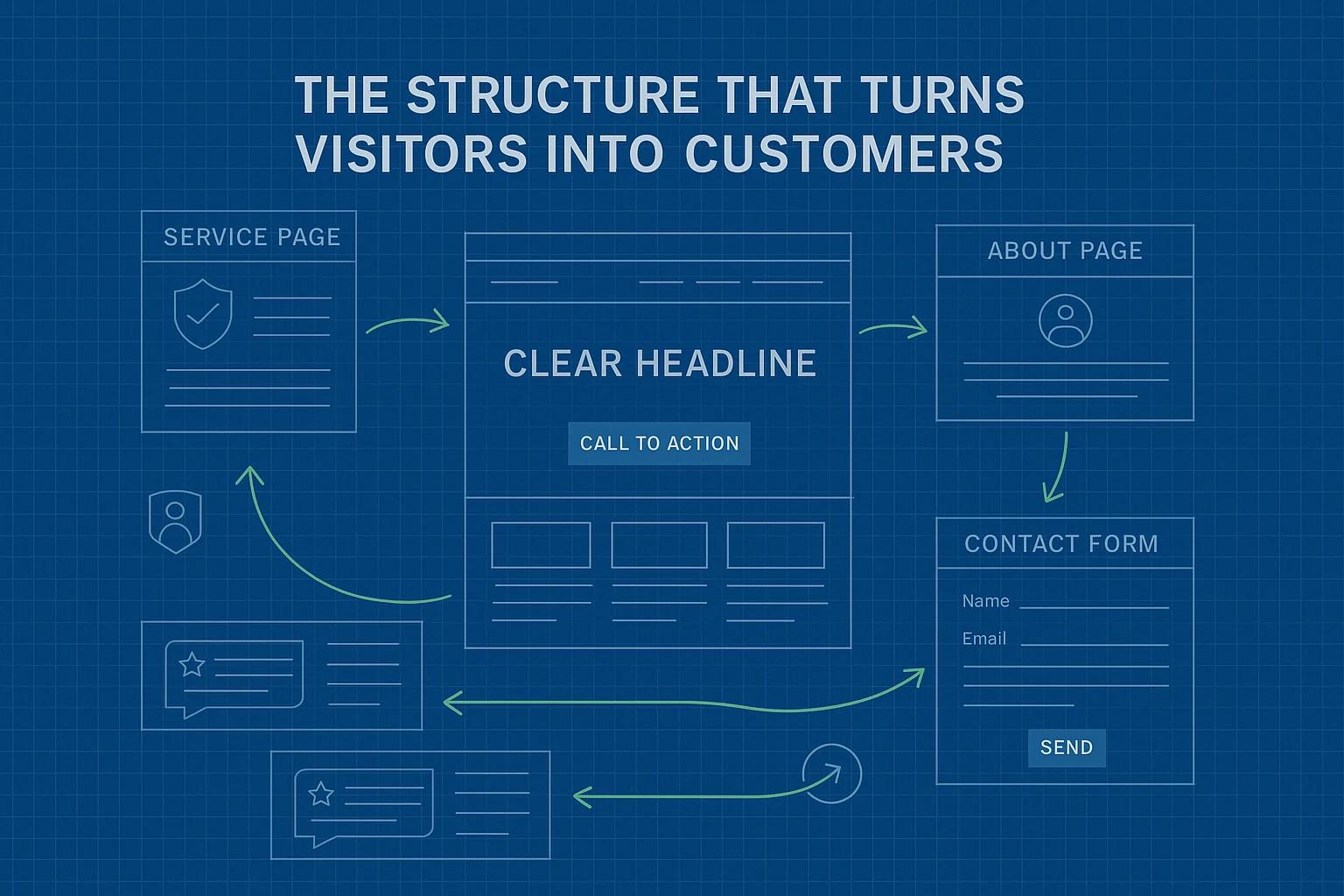
The problem often lies in the absence of clear calls to action or in making it too difficult for interested visitors to take the next step. Many small business websites assume that if someone is interested, they'll figure out how to get in touch. In reality, you need to guide visitors towards the action you want them to take.
The Simple Fix: Make It Easy to Say Yes
Converting visitors into customers starts with understanding what action you want them to take and then making that action as easy as possible.
Create clear, compelling calls to action. Every page on your website should have a clear next step for visitors. This might be "Call now for a free consultation," "Download our pricing guide," or "Book your appointment online." Make these calls to action stand out visually and place them prominently on each page.
Reduce friction in your contact process. If you want people to call you, make your phone number large and clickable on mobile devices. If you prefer email enquiries, create a simple contact form that asks only for essential information. The easier you make it for people to contact you, the more likely they are to do so.
Offer something valuable in exchange for contact information. This could be a free consultation, a helpful guide, or a discount on first-time services. You. could be increasing your leads by 200% by offering a free "Marketing Health Check" in exchange for contact details. There is a reason so many companies offer a value proposition for contcat details, it works when there is propper value on offer.
Use social proof strategically. Display testimonials, reviews, or case studies prominently on your website. Irish consumers particularly value recommendations from other local businesses or customers. Include photos and full names when possible to increase credibility.
Create urgency without being pushy. Limited-time offers, seasonal promotions, or highlighting your busy schedule can encourage visitors to act sooner rather than later.
The Compound Effect: When Everything Works Together
Here's what's exciting about implementing these fixes: they don't just work individually - they amplify each other. A fast-loading website that's mobile-friendly and easy to understand will rank better in search results. Better search rankings bring more visitors. More visitors, combined with clear calls to action, generate more leads and customers.
Imagine a local hardware store whose website takes over 12 seconds to load, looks terrible on mobile, and hides contact details deep inside a cluttered navigation menu. If that store were to optimise loading speed, redesign for mobile usability, and make contact information easy to find, it’s reasonable to expect they could see a dramatic rise in enquiries within a few months. Even better, those enquiries would likely convert at a higher rate because visitors could instantly understand what the business offers and how to get in touch.
The investment for such improvements is often modest, sometimes less than the cost of a single month of traditional advertising. Yet, the impact can completely transform how a website drives business growth.
Taking Action: Your Next Steps
Reading about these solutions is one thing; implementing them is another. The key is to start with the fix that will have the biggest impact on your specific situation.
If your website takes more than five seconds to load, start there. Speed improvements often provide the quickest and most noticeable results. If your site loads quickly but looks poor on mobile, make that your priority. If you're getting visitors but no enquiries, focus on your calls to action and conversion elements.
Don't try to fix everything at once. Choose one area, implement the improvements, measure the results, then move on to the next area. This approach allows you to see which changes are making the biggest difference for your business.
Remember, your website should be working for your business, not against it. Every day that these problems persist is another day of lost opportunities. But with focused effort and the right approach, you can transform your website from a digital liability into your most effective marketing tool.
The Irish small business landscape is more competitive than ever, but it's also full of opportunities for businesses that get their digital presence right. Your website can be the foundation that supports sustainable growth for years to come. The question isn't whether you can afford to fix these problems - it's whether you can afford not to.